
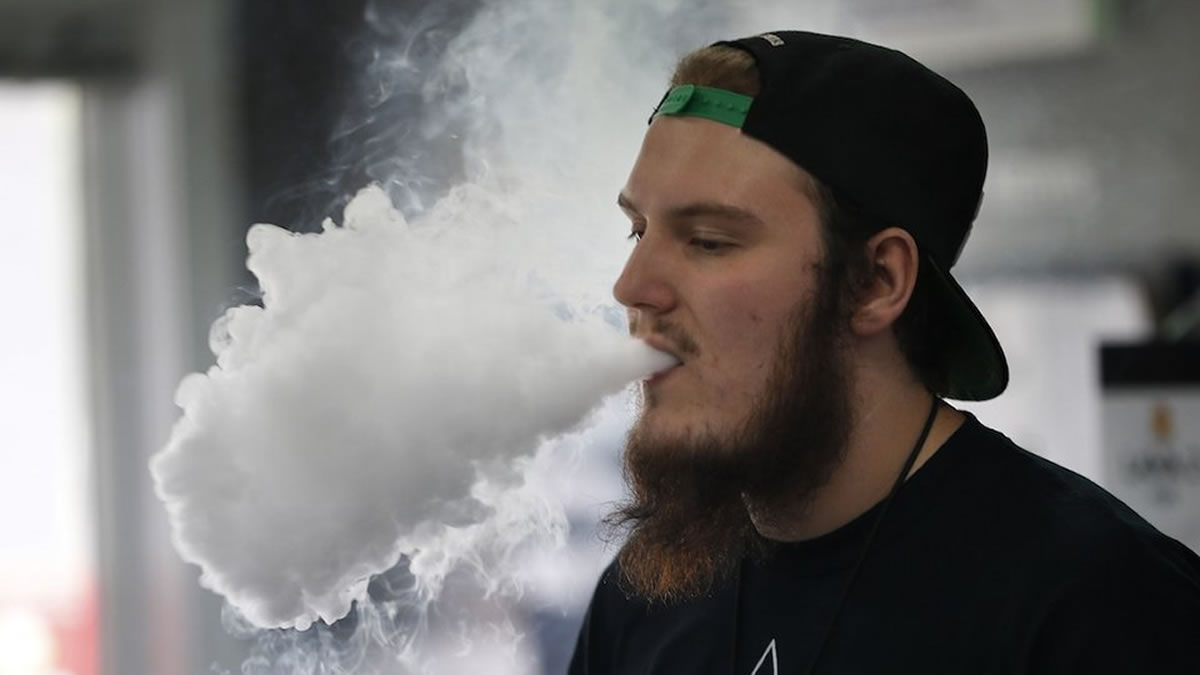

The U.S. Food and Drug Administration (FDA) has authorized fruit-flavored e-cigarettes for adults aged 21 and older, marking a significant policy shift that public health experts fear will increase ambient exposure to secondhand aerosols. This May 5 decision, reportedly influenced by presidential pressure, was quickly followed by an FDA announcement that it would deprioritize crackdowns on illegal e-cigarette sales for companies actively pursuing agency approval.
These regulatory relaxations arrive as data indicates a sharp rise in the number of bystanders involuntarily inhaling vape emissions. Despite a general decrease in direct youth e-cigarette use, the prevalence of secondhand exposure among adolescents has surged over the past five years.
| Year | U.S. Middle & High School Students Exposed to Secondhand Aerosols |
|---|---|
| 2018 | Approx. 33% |
| 2023 | 45.2% |
What Exactly is in Vape “Smoke”?
When a user exhales from a vape pen, they are not releasing harmless water vapor. The device’s heating component warms a liquid solution until it aerosolizes, suspending numerous chemicals in the air. While manufacturers disclose primary ingredients like nicotine, THC, propylene glycol (for moisture), and vegetable glycerine (for cloud thickness), the full chemical profile remains largely hidden.
A comprehensive 2021 analysis of popular vaping liquids identified over 1,000 unknown chemicals in the liquids and their resulting aerosols. Researchers also found caffeine, pesticides, and flavorings linked to toxic physiological effects.
Furthermore, the heating process itself creates new, dangerous byproducts. Yang Wang, an environmental engineering professor at the University of Miami, notes that unwanted chemical reactions during vaporization can produce formaldehyde, acetaldehyde, benzene, toluene, and various heavy metals.
- Nicotine & Stimulants: Highly addictive compounds that can be absorbed secondhand, particularly by children.
- Volatile Organic Compounds (VOCs): Created by heating flavorings; some studies show these can exceed federal workplace safety standards.
- Heavy Metals: Leached from the device’s heating coils into the inhaled and exhaled aerosol.
The Health Risks of Secondhand Inhalation
While the long-term health risks of secondhand aerosols are less documented than traditional secondhand smoke, emerging research paints a concerning picture. The sheer variety of devices and fluctuating aerosol outputs make standardized testing difficult, but early studies indicate clear respiratory and neurological threats.
Jeannie Rodriguez, a professor at Emory University’s nursing school, highlights that animal studies have linked secondhand aerosol exposure to weakened immune systems, stunted growth, and poor neurological outcomes. In human studies, a 2022 report found that young adults exposed to secondhand nicotine aerosols faced an increased risk of bronchitic symptoms and shortness of breath.
Additionally, indoor vaping significantly increases household air pollution, specifically fine particulate matter (PM2.5), which carries well-documented cardiovascular and respiratory risks. Studies from 2024 also confirm that children exposed to these aerosols absorb measurable amounts of nicotine into their systems.
Is Any Level of Exposure Safe?
Currently, researchers do not consider any amount of e-cigarette aerosol exposure to be entirely “safe.” However, experts differentiate between brief, passing encounters and chronic exposure.
According to Professor Wang, occasional short-term exposure—such as walking past a vaper on the street or at a party—is unlikely to cause clear long-term harm for healthy adults, though it may trigger acute coughing or asthma symptoms in sensitive individuals. The primary danger lies in repeated, sustained exposure, particularly in poorly ventilated homes or vehicles.
Source:
- NBC News, Fight over fruit-flavored vapes pushed FDA chief to resign, May 14, 2026
- NBC News, FDA announces its first OK of fruit-flavored e-cigarettes for adults in major shift under Trump, May 5, 2026
- NPR, FDA To Banish Flavored E-Cigarettes To Combat Youth Vaping, Sept. 11, 2019
- Cleveland Clinic, Vaping (E-Cigarettes): What It Is, Side Effects & Dangers, accessed May 18, 2026
- Association of Health Care Journalists, CDC finds ‘chemical of concern’ in vaping-relating illness investigation, May 15, 2026
- The Washington Post, Trump vows to ‘save’ vaping after private meeting with vaping lobbyist, Sept. 21, 2024
- Donald Trump’s Truth Social post, Sept. 20, 2024
- JAMA Network Open, Trends in the Prevalence of Exposure to e-Cigarette Aerosol in Public Places Among US Middle and High School Students, 2015 to 2018 | Public Health, Aug. 28, 2019
- Oxford Academic Nicotine & Tobacco Research, Secondhand E-Cigarette and Tobacco Smoke Exposure and Stages of E-Cigarette Use in US 6th–12th Graders, April 2026
- Chemical Research in Toxicology, Characterizing the Chemical Landscape in Commercial E-Cigarette Liquids and Aerosols by Liquid Chromatography–High-Resolution Mass Spectrometry, Oct. 5, 2021
- Johns Hopkins University, Johns Hopkins researchers find thousands of unknown chemicals in electronic cigarettes, Oct. 7, 2021
- The Real Cost, Vapes: product page, accessed May 18, 2026
- University of Rochester Medicine, Vaping and E-Cigarettes, accessed May 18, 2026
- NASA Earth Sciences, Aerosols and Their Importance, accessed May 18, 2026
- Healthline, JUUL Pod Ingredients: What’s in E-Cigarettes?, May 27, 2020
- Department of Justice and Drug Enforcement Administration, Drug Fact Sheet: Marijuana/Cannabis, May 18, 2026
- Chemical Research in Toxicology, Chemical Composition of Aerosols from the E-Cigarette Vaping of Natural and Synthetic Cannabinoids, Nov. 13, 2024
- American Lung Association, What’s in an E-Cigarette?, accessed May 18, 2026
- Biological Research for Nursing, Passive Electronic Cigarette Vapor Exposure in Children: A Systematic Review, July 9, 2025
- BMJ, Effects of electronic cigarettes and hookah (waterpipe) use on home air quality, Dec. 14, 2022
- McGill University Newsroom, Air pollution: The silent killer called PM2.5, March 11, 2021
- Environmental Science & Technology, Flavoring Compounds Dominate Toxic Aldehyde Production during E-Cigarette Vaping, Nov. 8, 2016
- JAMA Network Open Secondhand Nicotine Absorption From E-Cigarette Vapor vs Tobacco Smoke in Children, July 11, 2024
- PLOS One, Electronic cigarette power affects count concentration and particle size distribution of vaping aerosol, Dec. 31, 2018
- BMC Public Health, Passive exposure to e-cigarette emissions is associated with worsened mental health, June 7, 2022
- University College London News, Second-hand vaping exposure very low compared to second-hand smoking, July 10, 2024
- RGA, Nicotine and the Cotinine Test: The cost of consumption, May 18, 2026
- PLOS One, Benzene formation in electronic cigarettes, March 8, 2017
- National Academies of Sciences, Engineering, and Medicine, Toxicology of E-Cigarette Constituents, accessed May 19, 2026
- U.S. Centers for Disease Control and Prevention, E-Cigarette Use Among Youth | Smoking and Tobacco Use, accessed May 19, 2026
- The Associated Press, Thousands of unauthorized vapes are pouring into the US despite the FDA crackdown on fruity flavors, June 26, 2023
- Cureus, A Single 10-Minute E-cigarette Vapor Exposure Reduces Tidal Volume and Minute Ventilation in Normoxia and Normobaric Hypoxia in Adult Rats Oct. 9, 2023
- Health Policy via ScienceDirect, Is secondhand smoke associated with mental health issues? A narrative review of the evidence and policy implication, October 2023
- Drug Metabolism Review, Full article: Aldehyde toxicity and metabolism: the role of aldehyde dehydrogenases in detoxification, drug resistance and carcinogenesis, Nov. 28, 2018
- STAT News, No FDA permission, no problem: New flavored vape policy worries experts, May 11, 2026
- The New York Times, No FDA permission, no problem: New flavored vape policy worries experts, May 8, 2026
- The Brink, E-Cigarette Brands Are Skirting the Rules About Health Warning Labels on Instagram, Study Finds Sept. 13, 2024
- National Institute of Environmental Health Sciences, Smoking and Vaping | National Institute of Environmental Health Sciences, accessed May 19, 2026
- U.S. Centers for Disease Control and Prevention, About E-Cigarettes (Vapes) | Smoking and Tobacco Use accessed May 19, 2026
- Oxford Academic Nicotine & Tobacco Research, Unclear Labeling of Nicotine Products Poses Risks to Consumers, May 19, 2026
- MarijuanaPackaging.com, Compliance Checklist for Vape Packaging Across U.S. States, Jan. 21, 2025
- Cannabis & Cannabinoid Research, Requirements for Cannabis Product Labeling by U.S. State, April 19, 2022
- NPR, Flavored vapes are supposed to be illegal, but they’re still widely available, July 12, 2023